
Every April, Falls Awareness Month puts a much-needed spotlight on one of the most common, and most preventable, causes of injury among older Australians. This year is no different. But as the month wraps up, it's a good time to reflect on what actually helps in preventing falls.
Falls are the leading cause of injury-related hospitalisation and injury death among older Australians, and the risk doesn't follow the calendar. Prevention is something that works best as an ongoing habit, not a once-a-year conversation. So, whether you're reading this in April or any other month, here's a practical look at what the evidence says makes the biggest difference; at home, in your daily routine, and in how you use the support available to you.
Why falls deserve year-round attention
Beyond the physical impact (fractures, head injuries, extended recovery) falls can trigger a significant loss of confidence that changes the way a person moves through their own home and their own life.
Many people who experience a fall become cautious to the point of limiting their activity. They go out less. They move around less. And that reduced movement weakens the muscles and balance that help protect against falling in the first place.
This is why prevention matters so much more than reaction. Getting ahead of the risk, before a fall happens, protects not just physical safety, but independence, confidence, and quality of life.
What falls prevention actually looks like
Falls prevention isn't a single action. It's a combination of small, sustainable habits that work together over time. The good news is that none of them require a dramatic change to your life or your home.
Keep moving — especially in ways that build balance
Regular movement is consistently one of the most effective things someone can do to reduce their falls risk. Australia's 2025 Falls Guidelines recommend at least 2–3 hours of exercise per week, primarily targeting balance, strength, and mobility; on an ongoing basis, not just as a short-term program.
You don't need to join a gym. Walking, gentle stretching, tai chi, and chair-based exercises all help maintain the strength and balance that keep you steady on your feet. The key is consistency; the benefits build gradually and diminish if you stop.
If you're not sure what's appropriate for your current health and fitness, your GP or a physiotherapist is a great starting point. A tailored exercise program makes a real difference.
Have a conversation with your GP
A falls risk review with your GP is one of the most practical steps you can take and one many people don't think to ask for. Your GP can assess your individual risk factors, check whether any of your medications might be affecting your balance or coordination, and refer you to other health professionals if needed.
Certain medications (particularly sedatives, sleeping tablets, antidepressants, anti-epileptics, and some cardiovascular drugs) are known to increase falls risk. It's not about how many medications you take, but whether the type you're on has any effect on your steadiness. A review can answer that clearly.
Take a close look at your home
Most falls happen at home, in familiar spaces. According to the Australian Institute of Health and Welfare, one in two falls that result in hospitalisation occurs in the home. That familiarity can make it easy to stop noticing the things that have quietly become hazards such as a rug that's started to curl, a poorly lit hallway, a bathroom without grab rails.
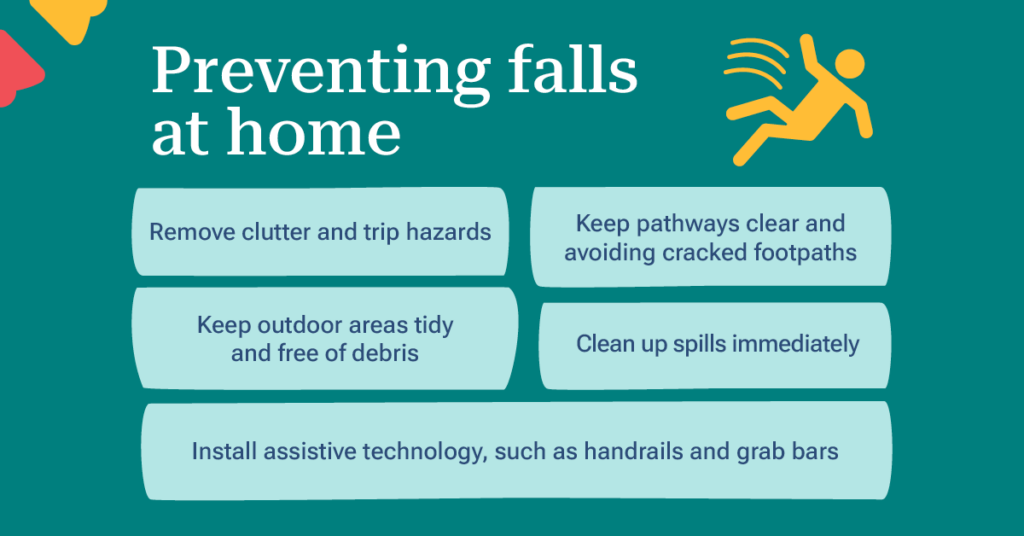
You don't need to renovate. Some of the most effective changes are simple: securing loose rugs, adding a night light on the path to the bathroom, clearing clutter from walkways, and making sure there's something stable to hold on to in the shower.
If you'd like a more thorough assessment, an occupational therapist can do a home safety review and recommend modifications specific to your situation.
Check your vision and your footwear
Two easily overlooked contributors to falls risk are vision and footwear. Changes to vision, even gradual ones, affect depth perception and the ability to spot hazards underfoot. If it's been a while since your last eye test, it's worth booking one.
What you wear on your feet matters just as much. Well-fitted shoes with a low heel and non-slip sole provide much better stability than worn slippers or socks on a smooth floor. It's one of the simplest changes a person can make, and one of the most effective.
A note for families and carers
If you're an adult child or carer reading this, you may already be thinking about the person you care for. Falls prevention conversations can feel delicate, nobody wants to make a parent feel like their independence is being questioned.
The most helpful approach is usually a collaborative one. Rather than arriving with a list of changes that need to happen, start with a genuine conversation about how they're finding getting around the house, what feels comfortable, and what has started to feel a little harder. From there, you can explore options together.
Small steps, taken with the person rather than for them, tend to land much better and stick.
How Support at Home funding can play a role
If you or someone you care for has Support at Home funding, it's worth knowing that falls prevention is a legitimate and meaningful use of that funding. Depending on your care plan, this might include physiotherapy, a home safety assessment by an occupational therapist, assistive equipment like grab rails or non-slip mats, or personal care support for tasks that feel unsteady. If a fall has already occurred, it may also be worth asking your provider about the Restorative Care Pathway; a structured, time-limited program designed to help people rebuild strength, confidence and independence at home.
At Trilogy Care, we work with clients to build care plans that reflect what genuinely matters to them. For many people, that means prioritising safety at home and using their funding in ways that support independence rather than just maintaining the status quo. As a self-managed provider, we keep our fees low so that more of your funding goes directly to the services and supports that make a real difference. Find out more about how self-management works, or explore our pricing to see how much more of your funding could go to care.
Call Trilogy Care on 1300 459 190 or visit trilogycare.com.au/getting-started to speak with a care partner about making the most of your Support at Home funding.
Falls Prevention Month is a useful prompt. It brings the conversation about falls to the forefront and makes it a little easier to raise with a GP, a family member, or yourself. That's genuinely valuable.
But the actions that reduce falls risk such as staying active, reviewing medications, making small changes at home work best when they become part of everyday life rather than something revisited once a year. The goal isn't to do everything at once. It's to start small, build momentum, and keep going.
If April has been the prompt you needed, that's a good thing. What matters now is following through.
The information in this article is general in nature and intended for educational purposes only. It does not constitute medical advice and should not replace consultation with a qualified health professional. Individual falls risk varies, and any changes to exercise, medication, or home modifications should be discussed with your GP, physiotherapist, or relevant healthcare provider. Trilogy Care does not accept liability for any loss or injury arising from reliance on the information provided.